contact

自然災害と不動産 これからの資産管理に必要な「備える」という視点」-Natural Disasters and Real Estate in Japan The Growing Importance of Prepared Asset Management-
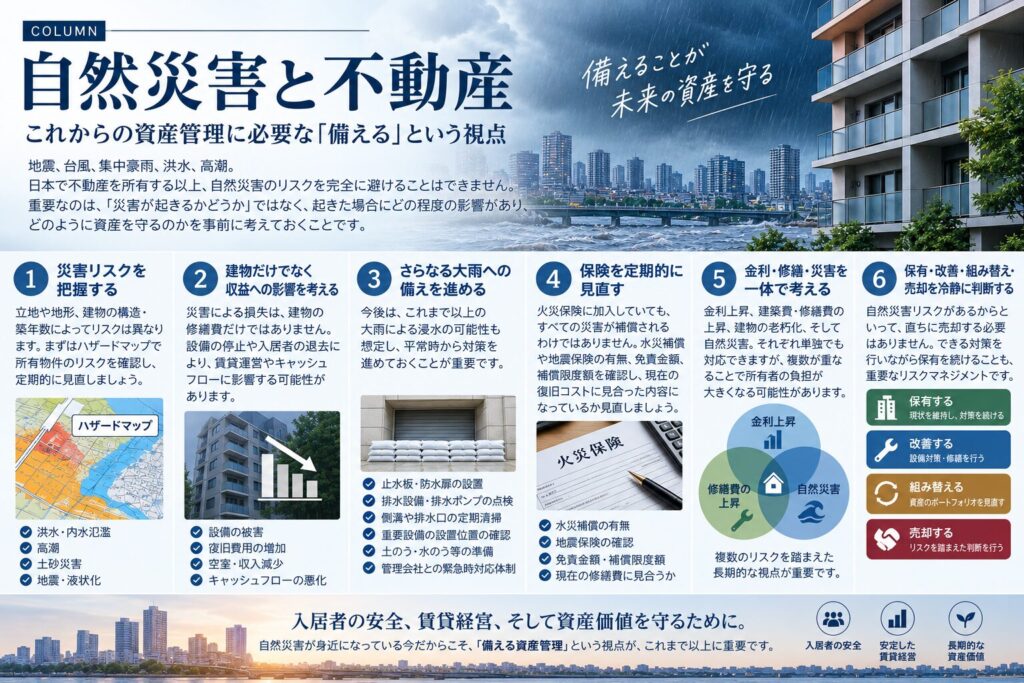
地震、台風、集中豪雨、洪水、高潮。
日本で不動産を所有する以上、自然災害のリスクを完全に避けることはできません。
重要なのは、「災害が起きるかどうか」を予測することではなく、起きた場合にどの程度の影響があり、どのように資産を守るのかを事前に考えておくことではないでしょうか。
災害リスクは物件ごとに異なる
同じ地域でも、立地や地形、建物の構造・築年数などによってリスクは異なります。
洪水、内水氾濫、高潮、土砂災害、地震、液状化など、まずは所有物件がどのようなリスクを抱えているのかを把握することが第一歩です。
購入時に確認したハザードマップについても、長期間保有している物件であれば、改めて確認しておくことが大切です。
建物だけではなく「収益」への影響を見る
一棟収益不動産の場合、災害による損失は建物の修繕費だけではありません。
エレベーター、受変電設備、給排水設備、機械式駐車場などが被害を受ければ、復旧まで時間を要する場合があります。
その結果、賃貸運営への影響や空室、収入減少につながる可能性もあります。
建物の被害 → 復旧費用 → 賃貸運営への影響 → キャッシュフローの悪化
自然災害は、建物だけでなく「収益」にも影響するリスクとして考える必要があります。
これからの建物管理では「さらなる大雨」への備えも
ハザードマップや保険を確認するだけでなく、今後の建物管理では、短時間の集中豪雨や、これまで以上の大雨による浸水の可能性も想定しておく必要があります。
特に地下・半地下部分、地下駐車場、エレベーターピット、受変電設備、機械室、給排水設備などは、浸水すると建物全体の機能に影響する可能性があります。
止水板や防水扉、排水設備・排水ポンプの点検、排水口の定期清掃、重要設備の設置位置の確認、土のう・水のう等の準備など、物件ごとにできる対策を検討しておくことが重要です。
また、管理会社や建物管理会社と、大雨や台風が予想される場合に**「誰が・いつ・何を確認し、どのような対応をするのか」**を事前に決めておくことも大切です。
災害が発生してから対応するのではなく、平常時から防災・減災を建物管理の一部として考える。
過去に浸水したことがない物件についても、将来の安全を当然視せず、今後の気象状況を考慮しながら備えておく必要があります。
保険も定期的に確認する
「火災保険に加入しているから大丈夫」とは限りません。
水災補償の有無、地震保険、免責金額、補償限度額などによって実際の補償内容は異なります。
建築費や修繕費が上昇している現在では、以前設定した保険金額が現在の復旧コストに対して十分なのかという確認も必要です。
金利・修繕・災害を一体で考える
不動産を取り巻くリスクは、自然災害だけではありません。
金利上昇、建築費・修繕費の上昇、建物の老朽化、そして自然災害。
それぞれ単独では対応できるリスクでも、複数が重なることで所有者の負担が大きくなる可能性があります。
これからは現在の利回りだけではなく、将来発生する可能性のあるコストまで含めて、保有不動産を考えることが重要です。
リスクがあるから売る、ではない
自然災害リスクがあるからといって、直ちに売却する必要があるわけではありません。
ハザード情報の確認、保険の見直し、浸水対策、設備点検、修繕計画、緊急時の対応体制、一定の手元資金の確保。
できる対策を行いながら保有を続けることも、重要なリスクマネジメントです。
一方、金利上昇、大規模修繕、建物の老朽化、災害リスクなどが重なっている場合には、資産の組み替えや売却を検討することも選択肢になります。
「保有する」「改善する」「組み替える」。
現在の収益だけではなく、これからのリスクまで把握したうえで判断する。
自然災害への備えは、建物を守るだけではなく、入居者の安全、賃貸経営、そして不動産の資産価値を守るための管理でもあります。
自然災害が身近になっている今だからこそ、**「備える資産管理」**という視点が、これまで以上に重要になっているのではないでしょうか。
Natural Disasters and Real Estate in Japan
The Growing Importance of Prepared Asset Management
Earthquakes, typhoons, heavy rainfall, flooding and storm surges.
Natural disaster risk cannot be completely avoided when owning real estate in Japan.
The important question is not simply whether a disaster will occur, but what impact it could have and how owners can prepare in advance to protect their assets.
Disaster risk differs from property to property
Even within the same area, exposure to natural disasters can vary depending on location, topography, building structure and age.
Flooding, inland flooding, storm surges, landslides, earthquakes and liquefaction are among the risks that property owners should understand.
For properties that have been held for many years, it may also be worth reviewing the latest hazard maps and local disaster information rather than relying only on information obtained at the time of purchase.
Consider the impact on income, not only the building
For income-producing properties, the financial impact of a natural disaster may extend beyond physical damage and repair costs.
Damage to elevators, electrical equipment, water and drainage systems, mechanical parking facilities and other essential infrastructure can interrupt building operations and require significant time to restore.
This can potentially lead to:
Physical damage → Restoration costs → Operational disruption → Lower rental income and cash flow
Natural disaster risk should therefore be considered not only as a physical property risk, but also as an investment and cash-flow risk.
Property management should prepare for more severe rainfall
Reviewing hazard maps and insurance coverage is important, but preparedness should go further.
Property management should increasingly consider the possibility of more severe rainfall and flooding and identify practical measures that could reduce potential damage.
Particular attention should be given to basements and semi-basement areas, underground parking, elevator pits, electrical equipment, mechanical rooms, drainage systems and other critical infrastructure that could be affected by water intrusion.
Depending on the property, measures may include flood barriers or watertight doors, inspections of drainage systems and pumps, regular cleaning of drains, reviewing the location of critical equipment, and preparing temporary flood-protection equipment.
Operational planning is equally important.
Owners, property managers and building management companies should establish in advance who will take action, when action should be taken, what should be inspected, and what measures should be implemented when severe rainfall or a typhoon is forecast.
Rather than developing a response after flooding occurs, disaster prevention and mitigation should become part of routine property management.
A property that has never flooded in the past is not necessarily free from future risk.
Insurance should also be reviewed regularly
Having insurance does not necessarily mean that every type of natural disaster loss is fully covered.
Flood coverage, earthquake insurance, deductibles and coverage limits can vary considerably.
With construction and repair costs rising, owners should also consider whether insurance coverage arranged several years ago remains sufficient for today’s restoration costs.
Interest rates, repairs and natural disasters should be considered together
Natural disasters are only one of several risks facing property owners.
Higher interest rates, rising construction and repair costs, ageing buildings and natural disasters can all affect investment performance.
Each risk may be manageable individually. However, when several risks overlap, the financial burden can become significantly greater.
This is why owners should increasingly look beyond today’s yield and consider the future cost and risk profile of their assets.
Risk does not automatically mean “sell”
Exposure to natural disaster risk does not necessarily mean that a property should be sold.
Reviewing hazard information, updating insurance coverage, improving flood protection, maintaining building systems, planning future repairs, establishing emergency procedures and maintaining sufficient liquidity are all important parts of risk management.
However, when several risks overlap — such as higher financing costs, major upcoming repairs, building deterioration and disaster exposure — reviewing the overall asset strategy may also be appropriate.
Hold. Improve. Rebalance. Sell.
The appropriate decision will differ for each property and each owner.
The objective is not to fear natural disasters, but to understand the risks and prepare for them.
Preparedness protects not only the building, but also tenants, rental operations and the long-term value of the asset.
As natural disaster risks become an increasingly important consideration, prepared asset management is becoming an essential part of long-term real estate ownership in Japan.
Opinion
相談したい
売却・購入以外にも、お客様の様々な不動産にまつわるご相談を承っております。
ご相談は無料です。お気軽にご相談ください。
安心してご相談ください

賃貸不動産経営管理士、不動産コンサルティングマスター、上級相続診断士が在籍しています。
お問い合わせ方法
06-6940-4083
9:30~17:30 水・日定休日
お問い合わせについて
コンプライアンスおよび不正防止の観点から、お電話・メールによるお問い合わせの際は、
お名前・ご住所(所在地)・電話番号・メールアドレスのご申告をお願いしております。
誠に恐縮ではございますが、必要事項をご申告いただけない場合や、ご本人様確認ができない場合は、お問い合わせへの対応をいたしかねます。
何卒ご理解とご協力のほどお願い申し上げます。